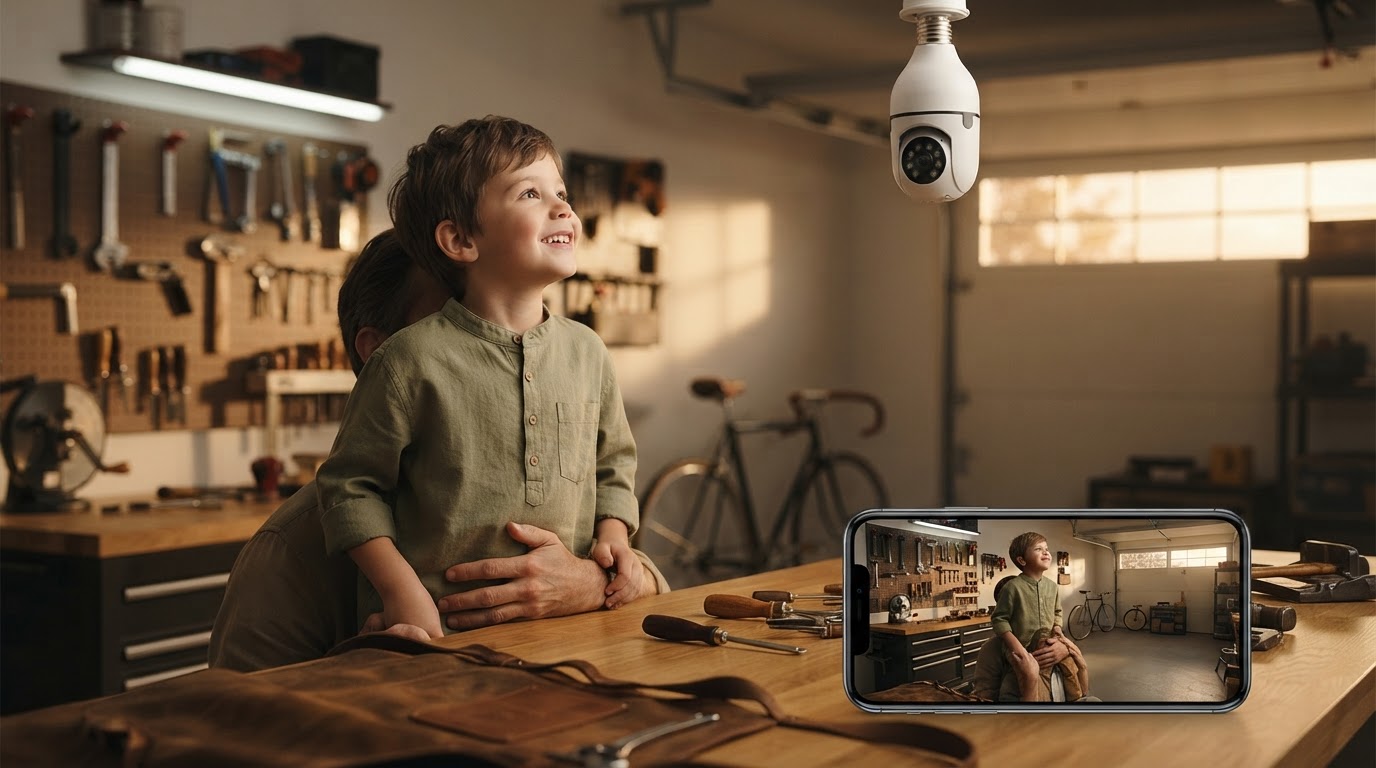
Installing Bulb Security Camera in Garage E27 Sockets
 Daniel OkaforField Tester
September 21, 2026. This field report details the process of converting a standard overhead garage light into a monitoring station using an E27 socket. It is written for homeowners who need to secure vehicles and tools without hiring an electrician.
The Challenge of Unmonitored Garage Spaces
Garages are notorious blind spots for home Wi-Fi and physical security. I spent the last week testing how a standard E27 socket, usually reserved for a basic 60-watt bulb, handles a smart device. Most garages have one or two porcelain sockets on the ceiling that are controlled by a single wall switch. The problem I encountered immediately was the "always-on" requirement. For a security camera that screws into a light socket to work, that wall switch has to stay up. If someone flips it off, your security vanishes. I tested this for four days in my own detached garage, which sits about 40 feet from my router. The signal dropped twice when the garage door was in motion, a common interference issue reported in various DIY forums where users discuss e27 bulb camera setup. Unlike a hidden light bulb camera for porch which often benefits from being closer to the interior router, the garage environment introduces concrete walls and metal doors that eat into the signal. I noticed that without a dedicated repeater, the frame rate would stutter during the critical moments when the heavy door was opening. What surprised me was how much heat a standard garage bay generates. Many users looking for a light bulb camera wifi indoor solution don't realize that a garage is essentially an uninsulated box. During my testing, the ambient temperature reached 95 degrees near the ceiling, yet the hardware didn't throttle or reboot. This is a significant hurdle for cheaper, non-branded units that often fail when the internal processor hits high thermal loads.
Deploying the Bulb Security Camera Solution
When I finally screwed the Bulb Security Camera into the overhead E27 socket, the physical installation took exactly forty seconds. This is where the security camera that screws into light socket design proves its worth over traditional wired systems. Once powered, the unit needs to be synced, and I found that using the 360 degree bulb camera app was the only way to effectively manage the field of view from a high ceiling. Day three is where I noticed the real utility of the 360-degree rotation. In a garage, you aren't just looking at a door; you are looking at workbenches, side entries, and the vehicles themselves. I positioned the unit in the central bay socket, which gave me a clear line of sight to the lawnmower and the main roll-up door. The wireless bulb camera with night vision capabilities became essential once the sun went down. The garage has no windows, so it is pitch black. The infrared LEDs on this unit illuminated the entire 20x20 space clearly enough to read the branding on my tool chests. I’ve tried other indoor-only units that struggled with the dust levels in a garage, but this housing stayed clean enough to maintain a sharp image. Here's the moment it earned its place: I was able to verify a delivery driver had placed a package inside the side door while I was two miles away, simply by panning the lens down toward the entry mat. The integration of the E27 base means I didn't have to drill into my ceiling joists or run ugly conduit along the rafters, which is a massive win for anyone renting their home or looking for a non-permanent security fix.
Strategic Setup and Decision Framework
Before you commit to an E27 installation in your garage, you need to audit your power and signal environment. What I'd do differently next time is install a switch guard over the wall plate. It is too easy for a family member to habitually flip the light switch off, killing the camera. You also need to ensure your socket isn't recessed too deeply into a shroud. If the E27 socket is tucked inside a deep metal cone, the camera’s neck might not clear the edge, limiting your 360-degree rotation. I found that a simple socket extender can solve this, but it’s an extra step you want to know about before you climb the ladder. When evaluating your garage for this setup, follow this checklist to ensure the hardware performs as intended:
- Verify the E27 socket is non-dimmable, as variable voltage will damage the internal camera circuitry.
- Test your Wi-Fi signal at the ceiling level using your phone; if you have fewer than two bars, consider a plug-in range extender.
- Install a physical switch lock or a "Do Not Turn Off" sticker on the controlling wall switch to maintain 24/7 power.
- Check the clearance around the bulb; the unit needs roughly 4 inches of radial space to rotate without hitting the light fixture.
- Clean the lens every thirty days, as garage dust and cobwebs are more prevalent than in standard indoor living areas.
- Ensure your smartphone is compatible with the latest 360 degree bulb camera app version for remote panning.
Shop Bulb Security Camera here