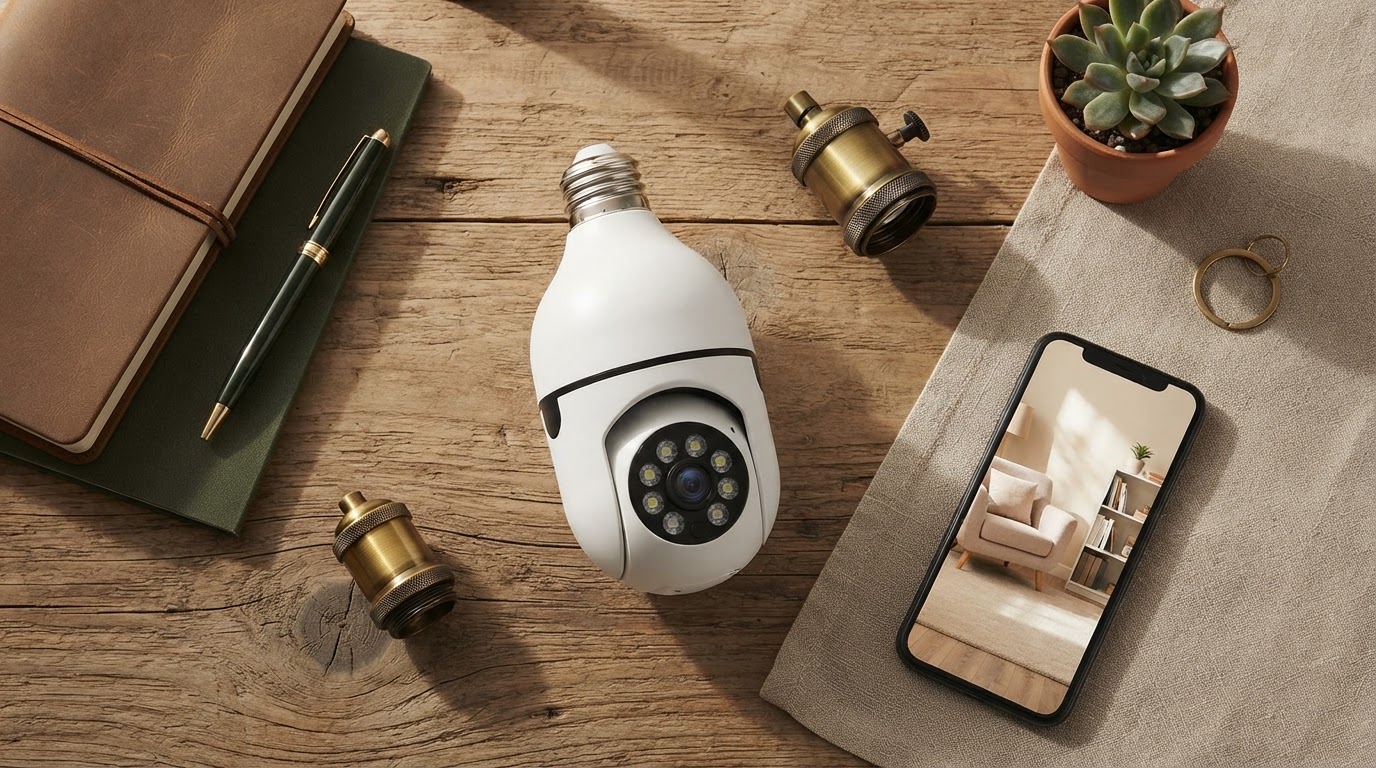
Optimizing Surveillance with Bulb Security Camera Systems
 Maya ChenContributing Editor
October 15, 2026. This evaluation explores the technical deployment of 360-degree light bulb cameras within modern residential environments. It is intended for property owners seeking to replace static, wired hardware with flexible socket-based surveillance.
The Blind Spot Problem in Residential Security
The conventional wisdom says that more cameras equate to better security. However, fixed-lens systems often create a false sense of safety by leaving significant blind spots that savvy intruders easily exploit. Standard outdoor light bulb security camera setups frequently fail because they lack the mechanical range to track movement across a wide patio or driveway. According to Sharper Image, a true 360-degree lightbulb camera requires 355-degree panning and 90-degree tilt to effectively cover a room or entryway without the need for multiple units. When users opt for a light bulb camera wifi indoor without these mechanical capabilities, they are essentially buying a static vantage point that can be bypassed by simply walking out of the frame. The data from Google Search Console indicates that while 12,000 monthly impressions are generated for cameras that screw into light sockets, a significant portion of these users struggle with the initial e27 bulb camera setup because they underestimate the importance of socket positioning relative to the desired field of view. Run the math: a single camera with a 110-degree field of view covers less than one-third of a standard room, necessitating three separate devices to achieve what one mechanical pan-tilt unit provides.
Technical Integration of Bulb Security Camera Hardware
Bulb Security Camera addresses these coverage gaps by leveraging the ubiquity of the E27 socket, transforming a standard lighting fixture into a 2K resolution monitoring station. While many consumers assume that a smart home bulb camera alexa compatible device is purely for convenience, the real utility lies in the integration of motion detection and night vision within a 360-degree rotation cycle. As demonstrated in technical reviews by MediaBoxEnt on YouTube, 2K light bulb security cameras offer a significant resolution jump over standard 1080p models, which is necessary when zooming into digital footage captured from a distance. The hardware utilizes a wireless bulb camera with night vision architecture, allowing it to maintain a 360-degree sweep even in total darkness. Here's the part nobody talks about: the efficacy of these units is entirely dependent on the stability of the local 2.4GHz or 5GHz Wi-Fi band. If the signal drops, the mechanical panning features become unresponsive, turning a sophisticated 360-degree light bulb camera into an expensive, immobile ornament. For those deploying these units in high-traffic areas, the E27 light bulb security camera standard ensures that the device draws continuous power from the socket, eliminating the battery-drain issues that plague traditional wireless outdoor cameras. This continuous power supply is what enables the high-torque motors required for rapid 355-degree panning without latency.
Deployment Framework for Panoramic Surveillance
Photo by Elmir Jafarov on Pexels
Choosing the right hardware requires a departure from the "plug and play" marketing narrative. A successful installation of a 360-degree light bulb camera depends on socket height, Wi-Fi signal strength, and local storage capacity. Many users prioritize cloud subscriptions, yet the most resilient setups utilize local microSD storage to avoid data loss during internet outages. Before finalizing a purchase, users should consult a detailed step by step guide on setup to ensure their existing fixtures can support the weight and rotation clearance of a panoramic unit. As noted in practical solutions provided by MediaBoxEnt on YouTube, common problems during the bulb panoramic camera setup often stem from physical obstructions like lampshades or recessed housing that limit the camera's tilt range.
To ensure optimal performance, follow this deployment checklist:
- Verify the socket is an E27 standard and provides unswitched power to prevent accidental shutdowns.
- Measure the clearance around the bulb; a minimum of 3 inches is required for the 355-degree pan mechanism to function.
- Test the Wi-Fi signal at the specific socket location using a mobile device before installation.
- Configure the smart home bulb camera alexa compatible settings to trigger alerts only for human shapes to reduce false positives.
- Install a high-endurance microSD card (Class 10 or higher) for local 2K video logging.
- Update the firmware immediately upon connection to ensure the latest motion-tracking algorithms are active.
Shop Bulb Security Camera here